

The Golfing World According to Ryan Bernberg:
The Mental Aspect of Golf:

- By Ryan Bernie “J Bomber” Bernberg

If you are reading this, I would assume that you have browsed our website. A significant portion of the website has been dedicated to the physical side of golf (Harmonising Gym to Golf) which is written by our very own protein muncher Dick “Mulligan” Gargler. Lots of players spend time working on their swing and the physical elements of their game. Why should they consider the mental side? In essence, the mental side of the game of golf is the most difficult part of the game to master – and to do so without instruction is even more difficult.
I will give you an example as to where the mental side of the game is an absolute killer! I will play a round of golf with my good friend Marsehole and he will be having a storming round (I am talking about 2 over through 11 holes). Now Marsehole has never broken 80 before and it is something that he would love to do! When he is not on my team, all I say is “Hey Marsehole, you only have to drop another 5 shots over the next 7 holes and you will break 80!!” It works every time! He will start to over-think the process, clog up and hit the biggest load of rubbish over the last 7. Now I know that it is not being a great sportsman, but dammit, when there are beers on the line, you will do anything to get the edge over your opponent.
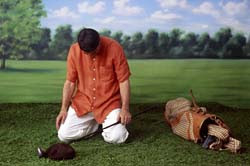
- The Good News? You can hit again
With all recreational golfers, the mental side of the game is not really considered to be important enough to warrant too much attention. I can guarantee you that learning how to control your thinking and emotions can have a substantial effect on how well and how consistently you play golf. In a round of golf, it is far more rewarding to eliminate the mental mistakes that you may make.
How many times have you played such a disastrous hole that it ruined the rest of your round? (I am definitely guilty of this). I cannot count the amount of times where I have had an absolute stinker of a hole which all of a sudden becomes 3 or 4 holes on the trot. The frustration that is felt can kill a man! It can happen to all of us, but the key to become a better player is learning how to “bounce back” from these shockers and develop the mental toughness to get the round back on track.
We have to accept that we all hit bad shots. It is our reaction to them which determines how well we play. Holding on to poor shots is extremely counter-productive. The longer we hold onto them, the more frustrated we become and the longer it will take to regain that lost confidence. The worst thing that anyone can do is to try the most miraculous recovery shot to make up for your bad shot – this will in all likelihood lead to a bigger number on the scorecard and could carry itself forward for another 3 holes.

- The Angry Golfer

The game of golf is all about confidence! We all know what that feels like. You know, that feeling that whatever is in your path shall be conquered. It goes without saying that the more confident you are, the better frame of mind you will find yourself in and ultimately, the better golf you play.
The best way to find the confidence to play a difficult shot is to remember a previous occasion when you have played a good shot with that particular club. Visualise your best shot. Professional golfers have a bank of good shot memories to draw on but most club golfers just seem to have a head full of bad shot memories. Recreational golfers frequently accept their good shots as if they hit them all the time, but react to bad shots with anger, disappointment and rage. Dwelling on the bad shots that you have dished out during the round will not improve your score at all.

- A classic SOS move

There is a saying that rings quite true: “The game of golf is played between the 6 inches of your head rather than the 150 acres of land that lies before you!” Most people will say that it is actually both (which can’t be disputed), but when you’re standing over a 10 metre breaking putt that’s downhill, or have a 170 metre carry over water, the space between your ears determines the outcome. Most sports – like cricket, rugby and football – are reactionary. Players have to react to a ball being bowled in excess of 130 kph, a pass from the scrumhalf or a shot for goal which needs to be saved. Golf is quite different. It requires deliberate decisions to be made between each shot and committing to your decision. If you make a mistake there is no one else to blame but yourself. There’s no teammate to bail you out. It’s just you, the club, the ball, and your mind.

Most golfers think that course management is what you do to get out of deep trouble. It is more than that. Course management comes into play on every shot with some shots being more important than others. A good mental game includes good course management. It requires you to plan and concentrate before every shot. The golf course is set up so you will make hundreds of decisions. Course management is smart golf; thinking positively to avoid mistakes. Since playing the ball only takes about 10 minutes in a four-hour round, decide how you will spend the time between shots to keep yourself in a positive frame of mind, loose and relaxed (beer usually helps).
Now I know that I have been rambling on about what you should or should not do – and I am definitely no psychologist or pro golfer – but maybe try improve the mental side of your game (and course management) and I guarantee that you will be shaving shots off of your score.
The mental side of the game is definitely something that I have been looking to control lately and the results are positive (well, only sometimes in all fairness). The worst that happens is that you try and control your mind, it does not work and you are in the same position as before.
Marsehole, I hope that this article will help you break your 80 this year mate!