

Back Exercise Part II:
Any golfer who has been playing the sport for long enough will know that sometime in their golfing career they have suffered, or will suffer, from some degree of lower back pain. The pain may only be a slight niggle or distraction, but could also be enough to ruin a round, or heaven forbid, keep you off the course for a week or two!
So, in keeping with our three part back strengthening plan, we will now deal with Part II, the ‘Lower Back’.
As a quick recap, Part I dealt with training the Lats (latissimuss dorsi) for the purpose of tensioning your back straight and upright to reduce and hopefully eliminate slouching, as well as increasing your compression strength. Avoiding slouching is important. Walking upright reduces the strain placed on your lower back as the muscles are no longer working to pivot your upper body vertical, in turn reducing the strain placed on the muscles.
Lower back pain, specific to golf, is caused by two main contributing factors.
The first is the constant bending and leaning a golfer does during a round. This includes things like, leaning over a putt so as to align your eye over a ball, bending over to pick up your golf bag, actually lifting and carrying the golf bag, and the multiple other physical tasks during a round.
The second contributing factor stems from actually swinging a golf club, and particularly swinging the club too hard, typically when driving from the tee box.
With regards to the second contributing factor the simple mechanics are as follows, when a golfer swings the club the upper body is rotated over the lower, anchored legs. This rotation around the pelvis, is made possible by the lower back rotating to turn the shoulders back in a clockwise direction, and then rotate them forward during the swing in a second, intensive, anti-clockwise direction (for a right handed golfer).
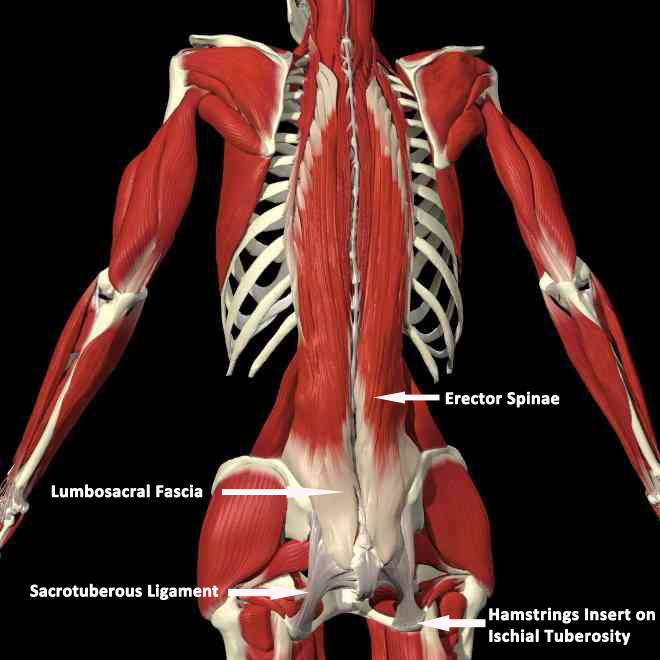
Two problems may ensure; Firstly if a golfer does inadequate stretching or warming up of their hamstrings, the pelvic rotation is reduced. The shortened hamstrings hold the pelvis in place and reduce or disallow much rotational movement of the region. This in turn causes the lower back to over extend to create, or allow, for the rotation required in executing a swing, it is this over extension that leads to the strain. Secondly the lower back after multiple rotations in a round will inevitably tire, weaken and be forced out of its normal functional limits, thus additionally giving rise to the strain.
So, to protect the lower back from over extension, and over exertion, we have ‘Lower back hyperextenions!’
Now before we go on. Lower back hyperextensions is a delicate exercise, seriously trust me on this one, your lower back is not the kind of muscle group where you want to ‘push it hard!’ Start training the muscle group with very light, or even no weights, and only do a few repetitions. Take your time with this one, build up your weights, form and repetitions slowly. Going too hard too fast on this one will result in serious injury, the kind of injury where you can’t lift yourself off the couch, trust me, I’ve been there!
The exercise;
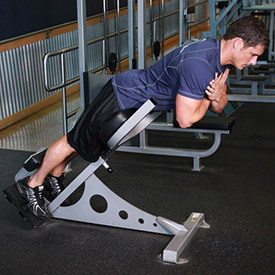
Lie face down on a hyperextension bench, tucking your ankles securely under the footpads.
Adjust the upper pad if possible so your upper thighs lie flat across the wide pad, leaving enough room for you to bend at the waist without any restriction.
With your body straight, cross your arms in front of you. You can put your hands behind your head as you slowly become more comfortable. This is now your starting position.
(Note: As you get stronger you can hold a weight under your chest in your crossed arms)
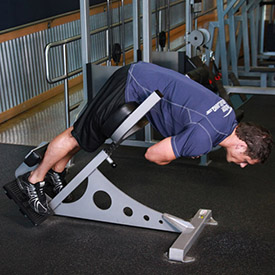
Start bending forward slowly at the waist as far as you can while keeping your back flat.
Keep moving forward until you feel a nice stretch on the hamstrings and you can no longer keep going without a rounding of the back.
Slowly raise your torso back to the initial position.
Now aside from strengthening the lower back to avoid stress and strain being placed on the muscle group, there are additional benefits to this exercise which will help with your golf swing, and of course, help in obtaining a stronger swing to send the ball further. This will be covered in part three of back exercises, namely the T-back Region which includes the Rhomboids, Teres major and minor, and Infraspinatus Muscles.
Till then, Feel the burn, enjoy the pain and yield the results!!

All exercises must be done with caution and the SOS Golf Tour is not liable for any injury.